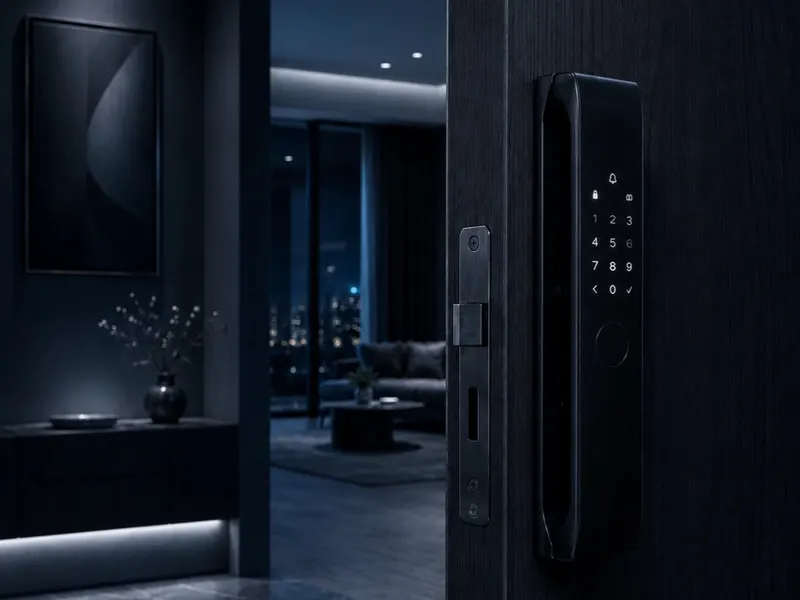
A smart lock OEM ODM program should treat the lock mechanism, enclosure, power source, credentials, embedded access rules, app, cloud permissions and production tests as one version-controlled product. The first useful brief defines the door and installation, user roles, access methods, offline behavior, software ownership and what the configured sample must prove.
Define the complete lock product boundary
A smart lock OEM ODM project starts with the physical lock and installation, but the release boundary extends through credentials, firmware states, accounts, permissions, event records and factory tests. Record the door type, mechanical interface, installation environment, power arrangement, user groups and expected operating workflow before choosing which reference lock to adapt.
Keep the reference configuration separate from project-specific changes. A new enclosure, motor, radio, battery arrangement, credential method or software flow may change what needs to be validated.
Set the first configured sample goal
The first sample should answer a short list of product decisions, not try to represent a finished production release. Define the mechanical fit, locking and unlocking states, selected credentials, onboarding path, account roles, event reporting and recovery behavior that must work together.
Ask for the hardware revision, firmware version, app build and cloud environment used in the sample. Open issues and temporary assumptions should remain visible so a successful demonstration is not mistaken for a production baseline.
Map credentials and access methods
List every intended access method, such as app control, keypad, card, fingerprint, key or temporary credential, and define who can create, share, revoke and review access. Separate local behavior from functions that depend on a network or cloud service.
For each credential, record enrollment, normal use, rejection, expiry, low-power behavior, lost-device handling and recovery. The lock, firmware, app and account model should use the same roles and state definitions.
Fix firmware, app and cloud ownership
Decide which party owns the app store accounts, cloud tenant, domain, notification service, source code or build handover, device keys, user data and ongoing operations. Define how device identity, account binding, shared access, event history, remote commands and software updates are handled.
Ownership is a delivery decision, not a label added at the end. It affects architecture, credentials, release access and the support process.
Plan representative pilot checks
A pilot should test the approved configuration in representative doors, user flows and connectivity conditions. Review installation repeatability, mechanical response, access methods, account sharing, event records, low-power states, alerts, reconnect behavior and recovery from interrupted operations.
Record issues against the exact hardware and software versions. If a finding causes a mechanical, electrical or workflow change, identify which previous checks must be repeated.
Release one controlled production baseline
Production release should identify the mechanical configuration, hardware revision, firmware and app versions, cloud environment, configuration data, programming method, functional tests, packaging and unresolved risks. Factory checks should cover the functions that distinguish a correctly assembled and configured lock from a unit that only powers on.
Changes after release should follow revision and issue control so samples, pilot units and production units do not silently diverge.
Supplier brief checklist
- Door type, mechanical interface and installation environment
- Preferred reference lock and required industrial-design changes
- Access methods, user roles and offline behavior
- Power source, charging or replacement expectations
- Connectivity, app, cloud and notification boundary
- Account, data, source-code and operating ownership
- Target markets and compliance-planning inputs
- What the first configured sample must prove
- Representative pilot conditions and acceptance decisions
- Production programming, functional-test and release-document needs