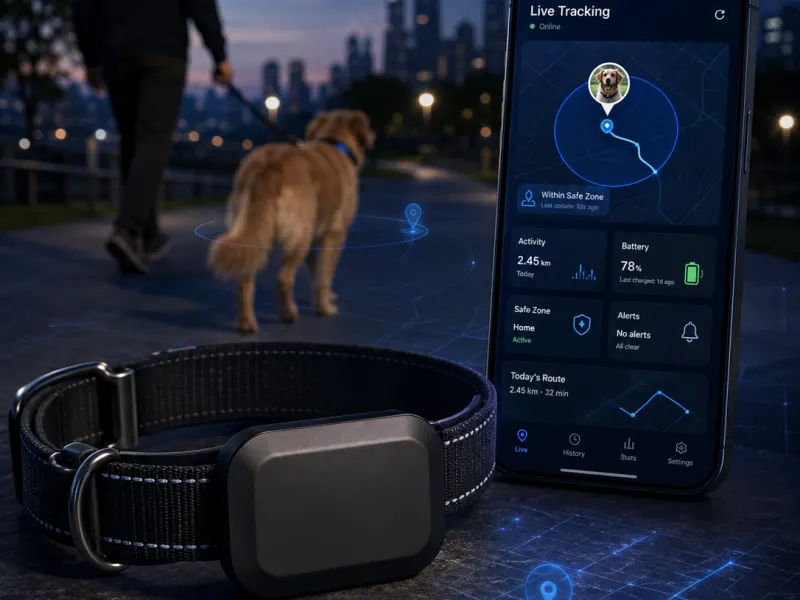
A GPS pet tracker OEM ODM program should define the wearable attachment, enclosure, cellular service, GNSS behavior, power profiles, map provider, alerts, accounts and subscription ownership as one product system. Coverage, location behavior and battery life depend on the selected hardware, network, reporting rules, environment and test conditions, so the first sample and pilot need explicit scenarios rather than headline promises.
Define the pet, attachment and use environment
Start with the animals, collar or harness arrangement, attachment method, expected movement, charging routine and the environments in which the tracker will be worn. The enclosure direction, retention, controls, indicators and charging access must fit the intended daily workflow.
Record which dimensions, materials and sealing decisions are fixed in the reference and which will change. Mechanical changes can affect antenna position, charging, retention and the checks needed for the final configuration.
Choose the network and service boundary
Define the target countries or regions, expected operator or roaming model, SIM or eSIM responsibility, activation flow, data ownership and who supports a failed or suspended service. The network choice should follow the intended mobility, reporting pattern, coverage and commercial service model.
Separate device supply from recurring connectivity and subscription operations. Identify who contracts the network service, bills the end user, handles account changes and manages service lifecycle events.
Specify location and reporting behavior
Describe when the tracker should request a location, how often it reports in normal and search modes, how safe zones work, what happens when satellite positioning is limited and which last-known information is shown. Define the relationship between GNSS, cellular, Wi-Fi or Bluetooth assistance only where those functions are part of the selected configuration.
Location results vary with antenna design, environment, movement, network access and software rules. Validate the configured device in representative outdoor, indoor-transition and weak-signal situations instead of treating one demonstration as a universal result.
Build the battery profile around real workflows
List the intended sleep, normal reporting, active search, charging, low-battery and offline states. Battery life depends on battery selection, signal conditions, positioning frequency, reporting intervals, alerts, temperature and user behavior. Use representative profiles and record the conditions behind each result.
The app should make the current mode and its effect understandable to the user. The production test should verify power and charging functions that can be checked consistently at the factory.
Define maps, alerts, accounts and subscriptions
Choose the map-provider boundary, account roles, pet profiles, device binding, shared access, safe-zone setup, notifications, history and customer-support workflow. Define who owns app-store accounts, cloud services, map accounts, user data, notification services and subscription billing.
The device data model, app screens and support process should use the same status and error definitions. This reduces gaps between what the tracker reports and what the user or operator sees.
Plan the sample, pilot and release
The configured sample should prove attachment, charging, onboarding, representative location and reporting flows, alerts and the intended account model. The pilot should add representative wear, network conditions, user handling, support events and version-controlled issue tracking.
Production release should fix the enclosure and attachment, electronics, antenna arrangement, battery, firmware, app and cloud versions, configuration data, programming method, functional tests, packaging and service ownership. Any change that affects radio, location, power or software behavior should trigger a review of the relevant checks.
Supplier brief checklist
- Target countries or regions and intended service model
- Animal sizes, attachment method and wear environment
- Enclosure, controls, indicators and charging direction
- Network, SIM or eSIM and activation ownership
- Location modes, reporting rules and safe-zone behavior
- Representative power profiles and charging workflow
- Map, alert, account, data and subscription ownership
- What the first configured sample must prove
- Pilot environments, users and support scenarios
- Production programming, test and release-document needs