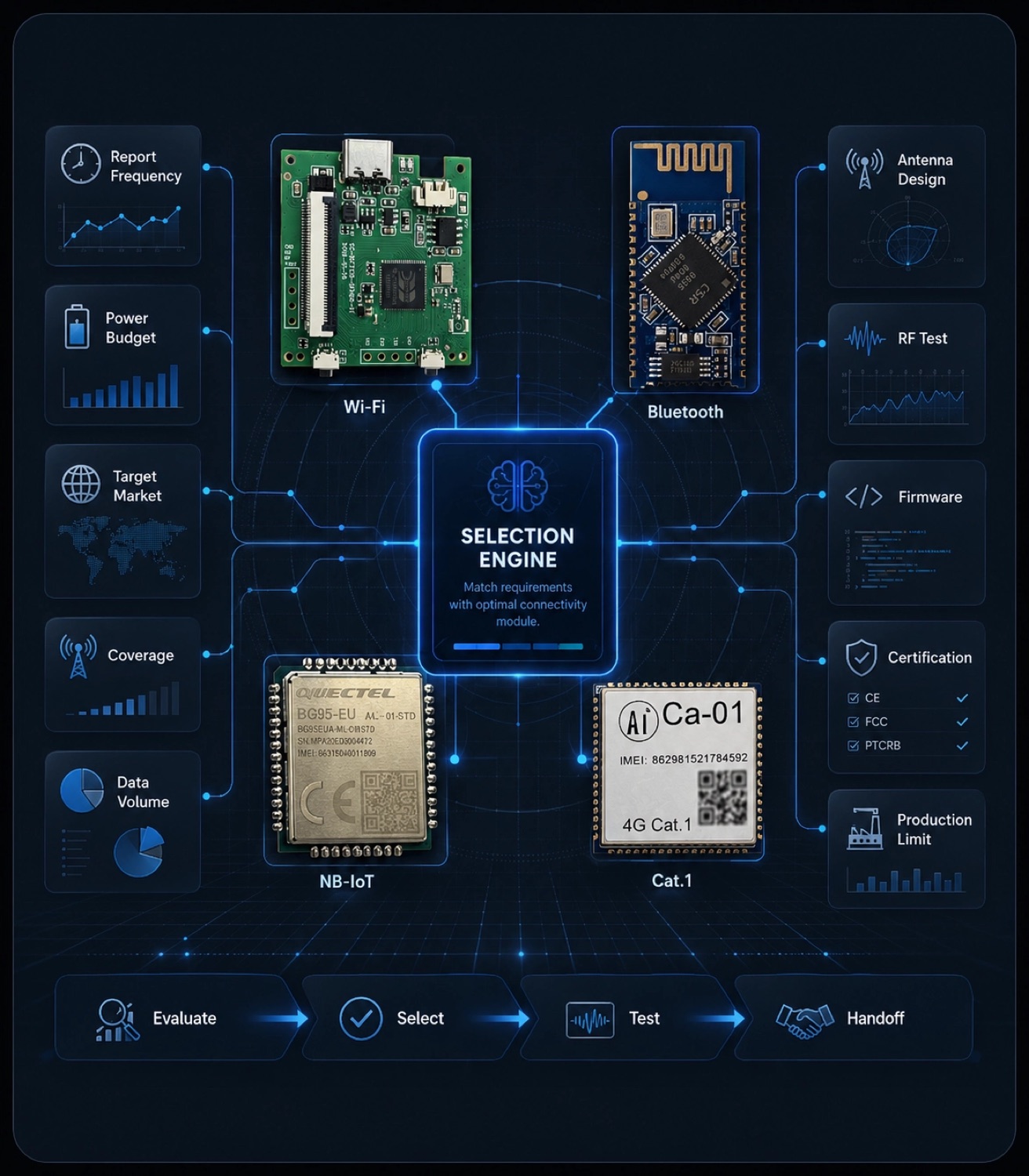
Choose an IoT module supplier by separating module-only supply from finished-product integration. Module-only buyers need availability, interfaces, RF support and document scope. Finished-product buyers also need antenna, firmware, app or cloud behavior, validation and production tests coordinated around the device.
Decide whether the purchase is module-only
A module-only purchase fits a team that already owns the product hardware, antenna, firmware, app or cloud integration and production validation. The supplier boundary can then focus on the part number, interfaces, documentation, availability and engineering support.
A finished-product program fits a team that needs those layers coordinated around a market device. Smart sensors, smart locks, pet trackers and monitoring terminals may all use cellular or Wi-Fi modules, but their power, data, enclosure and service requirements are different.
Start from the finished device constraints
Record the product category, target markets, enclosure and antenna space, power profile, data frequency, response needs, network access and expected volume. These inputs narrow the choice between Wi-Fi, Bluetooth, NB-IoT, 4G Cat.1 and LTE Cat.1.
Module-only qualification checklist
- Confirm the exact module and lifecycle status
- Review electrical and firmware interfaces
- Check antenna and RF support
- Match bands and operator support to target countries
- Review the scope of available compliance documents
- Define sample quantities and supply expectations
Finished-product integration checklist
- Map the module into the PCBA and enclosure
- Define power modes, reconnect and reporting logic
- Connect device identity to app or cloud accounts
- Validate antenna performance in the final mechanical design
- Test representative field and weak-signal conditions
- Release programming and communication tests for pilot production
Compare by product behavior
A fixed smoke, heat or presence sensor may prioritize long battery life, reliable event reporting and clear maintenance status. A smart lock balances access response, battery and local permissions. A pet tracker needs mobility, location updates and a subscription service. A monitoring terminal maps equipment events to an operator workflow. The same module recommendation does not fit every device.
Check document scope
A module certificate does not automatically approve the finished product. Record whether each file covers the module, antenna condition, radio configuration or complete device. Final market claims require the matching configuration and verified documents.
Compare the supplier’s production boundary
For a finished-product program, ask how the configured sample becomes a pilot: software versions, programming, fixtures, RF or communication tests, functional checks, issue records and release control. This separates component supply from a complete device-delivery role.
Official sources
- NB-IoT3GPP
- Mobile IoTGSMA
- Equipment AuthorizationFederal Communications Commission